
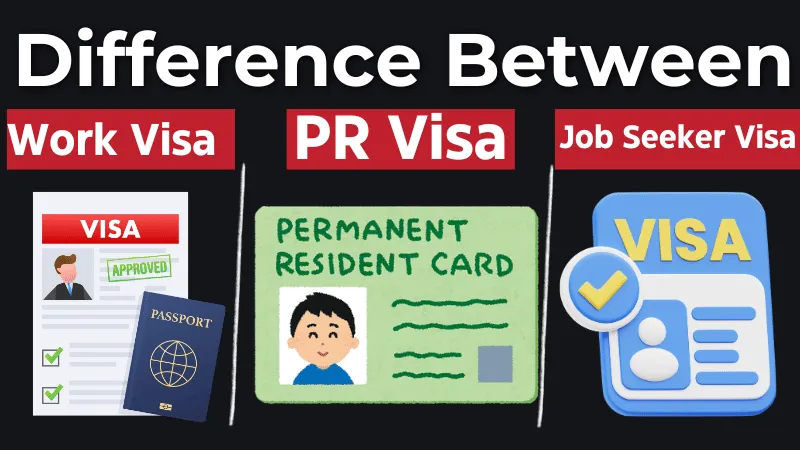
Information regarding visas of the different types is of the utmost importance when it comes time to make the move to a new country, especially to Germany or to another developed country. Students who are intending to immigrate often end up getting confused between a Work Visa, Permanent Resident (PR) visa and a Job Seeker visa.
These visas have specific for whom, the requirements needed to qualify for the visa and the benefits that come along with it, and therefore have differing application processes. Your choice can cost you several months or even years in delay, and can lead to rejection of your application.
This complete guide will explain each individual visa, their basic differences, guide you through each visa step-by-step and allow you to determine the right visa category for you and your particular situation. From experienced professionals and graduates to those looking for overseas career opportunities, this guide will help them make an informed decision.
What is a Work Visa?
A Work Visa is a temporary visa to be legal for an immigrant to take employment from a specific employer in a country. It is for those who already have an employer who has made them an offer of a job in the country where they want to relocate to. The work visa isn’t given as an incentive to find a job, it is meant to be deposited when you start working.
If you need a Work Visa, you need to be aware of the key characteristics of one to be eligible for it.
So, a work visa is essentially an employment visa. The features are:
- The visas are usually Tertiary: (1-3 years) in duration and will be aligned to the length of a work contract. If you lose or end work authorization, then your visa is invalid unless you find new employment or obtain a new visa classification.
- Multiple stages: No work visa is granted without having a firm job offer from an employer in the country of interest. An employer is required to be able to sponsor your visa application and have tried to potentially recruit locally first.
- Employment Restriction: Utmost employment visas give the holder many conditions, including, generally, a restriction on their employment. generally, it’s necessary to apply for a new work visa or blessing from immigration authorities to change employers. Some of the countries have limits on changing jobs within a specific time frame.
- Dependent Eligibility: In most cases, your spouse and dependent children are eligible to join you and apply for dependent visas, although they will not be eligible to work unless they can get additional work permission.
- Pathway to PR: There are many work visas which can lead to a permanent residence. Once you have had uninterrupted work for a certain amount of time (usually 3-5 years), you could be eligible to apply for permanent residency.
Common Work Visa Categories
The jurisdictions provide different types of work visas. The EU Blue Card in Germany, for instance, is meant for highly qualified professionals, who hold a University degree. If people have known expertise in their professional field they can apply for the Skilled Worker Visa. Other popular work visas are the Australian Skilled Independent Visa and Canada’s Skilled Worker Visa Program.
Work Visa Advantages
- Immediate Employment: You have a job that is waiting and can provide you with financial stability,
- Lengthy PR procedure: Many countries have expedited paths for people to get PR when they have a work visa.
- Family Sponsorship: Usually a more straightforward pathway to having a family member move to Canada as a dependent visa sponsor.
- Employer Support: Your employer can help with housing, integration and visa processing
- Skilled Worker visa tax benefits: Some countries provide tax incentives to skilled workers
Work Visa Disadvantages
- No eligibility for a transfer: If one cannot get another employer to accept a transfer to a new position, there is limited flexibility in switching employers without reapplying.
- Face the Risk: Whether you face the risk of losing your job, and therefore your visa, depends on the type of employment and how employment is tied to your visa status.
- Limited Duration: It remains valid only as long as you are working; will need to be updated on an on-going basis.
- Limited Work Rights: Dependent members of the family might have limited work rights
- To receive regular employer support and reporting is a requirement of Administrative Burden.
Also, Check Out This Article if You Plan to Move to Germany and Build Your Career There: How to Get a Germany Work Visa in 2026: Requirements, Process & Application Guide
What is a Job Seeker Visa?
A Job Seeker Visa, skilled independent visa or employment search visa, is a temporary visa that is specifically granted to people who are looking for a job in a country. In contrast to a work visa, this visa may be obtained without a definite job position being offered. Rather this visa enables you to enter the country, look for a job and apply for jobs in the country.
A Job Seeker Visa includes key characteristics.Characteristics of a Job Seeker Visa.
A crucial point of a job candidate visa is there is not a demand to have a job in order to apply for the visa. No, you do n’t need a job to apply for this, so it’s also suitable for those looking to explore implicit job options or career changes.
- Tone adequacy: demand Must demonstrate fiscal tone- adequacy in carrying out a job hunt. This is generally in the form of real savings or fiscal support.
- Limited Duration: Job candidate visas are valid for a specific period, generally ranging from 6 months to 2 times, depending on the country and visa order. After this expires, you’re entitled to one of two options: getting a job( and carrying a work visa) or leaving the country.
- Another important aspect for inflexibility: in employment is the ease of applying from within the country rather than overseas for a job candidate visa to a work visa.
- Search From Within: Being in the country and looking for work: One advantage is being physically present in the country when looking for work, and getting networking opportunities and being able to interview first-hand.
- Multiple Job Opportunities: They apply for Multiple job offers, a job seeker visa lets you apply to multiple employers and explore a few industries instead of the work visa being tied to a single employer.
Types of Visas Globally
The Settlement Permit (Aufenthaltserlaubnis) is issued to skilled workers, and has objectives similar to the Settlement Permit for refugees. The Job Search Visa is a visa given to skilled workers to look for job opportunities in New Zealand. A graduate visa in the UK grants opportunities for recent graduates to look for employment opportunities. There are also job categories in Denmark and Australia.
Benefits of Job Seeker Visa
- Job Jumping: Look for positions in a number of industries and job markets
- Career Exploration: Ideal for scholars who do n’t know what places or employers are of interest.
- Transition Support: May also give support services for job dogging and employment agencies.
- No Pre-commitment: Don’t take the plunge and sign the contract until you fully grasp what an employer requires.
- Easier Employer Transition: Switchers from employers are simpler than for work visas!
Disadvantages of a Job Seeker Visa
- Financial Requirements: Will have to show considerable savings (usually €8,000-15,000)
- Limited Duration: are those that have a time frame in which to find work before their visas expire.
- None had the Guaranteed Success: which is not available with a job visa. The great need to get employment is a reason that makes one get the wrong job.
- Work Experience: No experience necessary at this point.
- Dependent Challenges: Can be grueling to dominate the family members using this visa order.
What is PR?
Permanent Residency also known as PR is a permanent status of residence in which you legally have the right to live, work and study in a country permanently. Having a PR visa is more stable and stable than a temporary visa. You are not confined to a particular employer, your residence is not subject to the exclusionary rule but, with the exception of the right to vote and the right to hold certain positions in government, most of the rights and benefits enjoyed by citizens are open to you.
Key points about Permanent Residency:
- Indefinite Duration: PR can’t be perceived as an “until”. When issued, it does not have an expiry date (however some countries may need the actual card or document to be renewed periodically). That’s what gets us “real” long run security.
- Employment Freedom: You may work wherever you desire as an employee, change work as you wish, start a business or work as a freelancer without further permission. There will be no need for any of you to have an employer to sponsor you. When you have PR then you can work with anybody.
- Family Sponsorship: PR holders can usually sponsor spouses, dependent children and occasionally parents or other family members to join them.
- Access to Social Benefits: PR holders have access to services of healthcare, education, unemployment, social services etc., available to residents.
- Most countries to citizenship are acquired through a pathway to citizenship—PR status. After some years (usually 3-5 years of PR status) you can be able to apply to get citizenship.
- Travel rights: It is possible to travel in and out of the country and it is likely that a traveler will need to travel with an original passport.
Difference between PR and Work Visa
This perhaps ranks as the most crucial difference: PR is permanent and independent of an employer whereas a work visa is temporary and depends on the employer. As a work visa holder, you have to continue working or you may lose your privileges. As per PR, no difference in residence status would be seen if one changes their job.
PR Requirements
The eligibility criteria differ between countries for the PR eligibility trails. Common pathways include:
- Age and Education; Language proficiency; Work experience and flexibility; Points-Based Systems: countries like Australia and Canada have a points based system. You need to attain a certain number of points.
- EBPR: After a certain period of time (usually 3-5 years) of work visa holders staying in the country, they can apply for the PR visa without competing for points.
- Investor Programs: There are countries which provide PR to investors who make a substantial investment in a country.
- Philanthropic Refugee Programs: PR can help vulnerable populations to pierce it via philanthropic entry points.
- Family backing: PR holders or citizens can finance family members who are eligible for PR.
Advantages of Having PR
- Real and lasting security membership: no need to renew. Work – any industry, anywhere, whoever.
- Ownership of Business: We are able to create and manage our own business without anybody else.
- Social benefits – health, education and social services.
- Page 475: Family Sponsorship – have family in your household.
- Pathway to Citizenship: Clearly defined pathway to a full citizenship in case desired.
- Non Employer dependence: Loss of a job does not impact on your status of residence.
- Investment Opportunity: The country provides a greater incentive to invest in the country long-term.
Permanent Residency Disadvantages
- Long Process: Several years normally are required for a person to get P.R.
- Requirements: This will typically require 3-5 years of previous residence or work.
- Very Competitive Programs: Points-based are highly above average competitions.
- Geographic Restrictions: There are some countries that restrict geography where the PR holders can reside.
- The places of Maintenance: In some countries a residence is required, or recurring, is demanded.
- Indirect cost of PR application: Of course, the expense of PR application can also come back in significant bundles (in between 2 000 and 5000).
- Language Requirements: It is mandatory that language requirements are in many countries.
- Processing Time: PR processing could take 6-12 months or even longer (PR applications).
Step-by-Step Application Process
Application Process of Visa to work.
Step 1: Secure Employment
Directly contact employers, employ job boards or proceed through recruitment agencies. When you are offered a job. make sure that it is written and that salary, position and starting date is put down clearly.
Step 2: Employer Sponsorship
To demonstrate to the immigration officials that they have posted the job to the local candidates and chose you due to qualifications, your employer provides documents to immigration officials.
Step 3: Bring all the Documents
Prepare pukka clones of warrants, instruments, passport runners, birth instrument, police concurrence, employment contract and fiscal documents.
Step 4: Went for Interview
Go to the nearest delegacy or consulate and make an appointment with the visa interview through their sanctioned web point.
Step 5: Bring all the Documents
shoot all the necessary documents, along with the particulars of the particular roster used by the delegacy. Make sure that all papers are certified and in case they’re restated as well.
Step 6: Attend Interview
Turn up to a needed interview. Discuss your job, qualifications, and living plans. Please know how to respond to questions in the local language should this be necessary.
Step 7: Biometric Collection
Get finger prints and photographs for the biometric visa.
Step 8: Decision and Issuance.
Allow 4-8 weeks (or 2-3 weeks to process priority) to get your visa decision.
Step 9: Travel to Country
The visa must be issued within 90 days after which the visa holder must enter the country within the coming 90 days.
Step 10: Original Registration
Register with original authorities( Anmeldung in Germany, and so forth) within 14 days of appearance.
Job Seeker Visa Step By Step Application Process
Follow the steps below:
Step 1: Assess Eligibility
Make sure you are of age (age should be 20-45 years old), possess the necessary qualifications (a bachelor degree or a professional qualification), and have enough savings.
Step 2: Financial Documentation preparation
Prepare bank statements illustrating savings to typically 6-12 months of living expenses (€6,000-15,000 depending on country and time).
Step 3: Document Collection
Include passport, diploma/qualification certificates, evidence of financial capability, passport- size print and any other attestation of work experience.
Step 4: Went to Embassy
Apply at the nearest delegacy or consulate to find out the operation procedures and applicable documents.
Step 5: Bring all the Documents
deliver your properly filled operation form with all documents supporting the same at the delegacy.
Step 6: Went for Interview
Certain nations can ask an interview to determine your intentions and qualifications.
Step 7: Visa Application
In 2- 6 weeks, you’ll be informed of your visa decision.
Step 8: Went to the Country
Take a flight to the country and locally appear as necessary.
Step 9: Look for the Job
Initiate active employment- seeking by job boards, reclamation agencies, networking and direct employer operation.
Step 10: Employment Transition
After you have set up a job, change your job candidate visa to work visa, by having your employer request work authorization
Step By Step Permanent Residency Application Process
Follow the steps below:
Step 1: Period of Work Visa
Usually, one must have 3-5 years of experience on the work visa before he or she applies to PR.
Step 2: Evaluate (option) Points
The points-based must do your scores based on age, education, language skill, work experience and adaptability.
Step 3: Bring all the Documents
Prepare employment letters, duty returns, police concurrence, medical examination results, passport clones, and language test results.
Step 4: Put Application
Complete the full PR application form as well as provide detailed personal, educational and work history.
Step 5: Supporting Documents
send all the needed documents such as references conducted by employers, education qualifications and character references.
Step 6: Medical Examination
Carry out a medical check up by a paneled physician who is allowed to check up on your health condition.
Step 7: Language Test
Present the evidence of the language competence by way of the recognized tests (IELTS, TOEFL, GOEThe, etc.) results.
Step 8: Police Clearance
Get the certificates of police clearance in each country where you lived over 6 months.
Step 9: Application Submission
All application forms should be provided to the immigration authorities with due fees.
Step 10: Processing and Decision.
Wait processing; an average processing normally takes 6 -12 months. During this time you can be asked to provide further information.
Step 11: PR Approval
Get your PR approval and have your permanent resident card or certificate.
How to Switching Among the Visas
Follow the steps below
Work Visa to PR
This is the most prevalent transition. Upon 3-5 years work visa status:
- Check that you have the PR eligibility criteria.
- Assemble job records and references.
- Full usage of PR during employment.
- When you have the work visa approved, convert your work visa into PR.
- Once converted, have freedom of employment.
Job Seeker Visa to Work Visa.
In the event you get a job:
- Get your employer to seek work authorization.
- Change in job seeker visa to work visa.
- This normally consumes 2-3 weeks.
- Start a new job as a result of new visa status.
PR to Citizenship
PR status: After a typically 3-5 year time span:
- Verify citizenship eligibility requirements
- Complete citizenship application
- Succeed on citizenship tests (language, civics, history)
- Attend citizenship ceremony
- Get a new passport and citizenship certificate.
Significant Concepts and Frequent Fallacies
- Expenses: Don’t underestimate the costs. In addition to the visa fees, plan ahead on translations (price varies, but at least 15-30 per document), health insurance (about 100-300 a month), accommodation deposit (about 500-1500), living expenses.
- Documentation Organization: Have all documents in a good form both on-line and a hard copy. Sample all, then send original. The most popular reason behind visa delays is missing documents.
- Language Preparation: Although it may not be a strict rule, by learning the local language, it is likely that you will greatly increase your opportunities. Integration courses are offered to people free or subsidized by different countries.
- Timeline Realistic Expectations: The time between the job offering and the issuing of the visa can take 3-6 months. Avoid expecting too much of yourself or your employer in regard to unrealisticities in timelines.
- Employer Selection: Under a work visa, you are bound to your employer with the visa term. Choose carefully. Using a job seeker visa, you will have time to contemplate opportunities.
- Family Considerations: In case the family members are to be brought to the country, consider the visa processing time and the plus costs. Arrange to make up what you intend to do at the same time as your own plan.
Sum Up
The distinction between work visas, job seeker visas and permanent residency is a key element in the planning of successful international relocation. Different types of visas are oriented to the different purposes of visas and are appropriate in different life situations.
A work visa is ideal when you already have an established employment- it is the quickest place to work and live in another country. The job seeker visa would be the best option; whereby, you would have the flexibility to explore the opportunities available without having to make a commitment to a particular employer in advance. The final end of those who wish to have a long term settlement is permanent residence which has a complete employment privilege and security.